

http://www.politico.com/news/stories/0212/72840.html
“Dogs Against Romney” is taking its grievances against the presidential candidate to the Super Bowl of dog shows on Tuesday – the Westminster Kennel Club Dog Show.
The group, founded in 2007 to demonstrate against an infamous incident from the 1980s in which Mitt Romney’s family dog was subjected to ride on the roof of the family car for hours, is planning to rally in front of Madison Square Garden during one of the American Kennel Club’s biggest dog shows of the year.
Showing posts with label Pets. Show all posts
Showing posts with label Pets. Show all posts
Wednesday, February 15, 2012


Monday, December 12, 2011
Doggies 2, Hunters 0.
http://www.baynews9.com/article/news/2011/december/356302/Hunter-reportedly-shot-by-dog-near-Wesley-Chapel
http://www.boston.com/news/daily/25/odds_dog.htm
http://www.boston.com/news/daily/25/odds_dog.htm
Wednesday, December 22, 2010
Air Bear (the good kind)
From a friend on the politics board:
http://www.mercurynews.com/los-gatos/ci_16559405?source=most_viewed&nclick_check=1
http://news.yahoo.com/s/yblog_localsfo/20101110/ts_yblog_localsfo/so-many-medals-he-can-bearly-remember
He's had the stuffing knocked out of him a few times, but Lt. Col. Chester E. Bear still managed to parachute behind enemy lines during the Korean War and also serve in Vietnam and the Persian Gulf. At one point, Chester even visited the South Pole.
That's a pretty illiustrious military career, especially for a teddy bear.
View more photos.
Chester's story began in 1950 when 3-year-old Katy Toole gave him to her Air Force father to take on a humanitarian mission. "I had to fly an iron lung to a little girl and Katy said, 'Give the little girl my teddy bear.' After the girl got better she sent Chester back," retired Lt. Larry Toole said.
The 89-year-old Toole flew B24 bombers in WWII and served in the Air Force Reserves after the war. "One day Katy was playing on the lawn with her teddy bear and a neighbor who was also in the reserves said, 'We need a mascot like that.' He was just kidding," Toole said. "But Katy overheard and said, 'Why don't you make my teddy bear the mascot?' "
Seemed like a great idea at the time, and Chester was promptly enlisted and outfitted. "The officers' wives sewed his tiny uniforms," Toole said.
In 1952, when Toole was called up to serve in Korea, Chester went to war, too. "We had four squadrons, and we passed him around from squadron to squadron," Toole said.
Along the way, Chester even learned how to parachute. "He had a 20-foot-long red ribbon for identification," Toole said. "We threw
him out the rear of the airplane with other jump troops. When they threw him out, he had a cable that automatically opened his chute."
Chester's reputation grew far and wide. "Once in Korea when he jumped, the infantry got him and they wouldn't give him back," Tolle said. Chester was declared missing in action for about three weeks before he was returned.
Chester is named for Maj. Gen. Chester E. McCarty, who is the former commander of the 10th Air Force. "Maj. Gen. McCarty was our commanding officer," Toole said, "and he took the bear with him to many bases. He took a liking to him and babied him. Chester was Air Force property."
With all that traveling about and jumping out of airplanes, Chester got a bit beaten up. "He's been restuffed five or six times," Toole said. One time he was "treated" for a torn ear, but accounts of the time say he did not report to sick bay.
Fast-forward to 1966: Katy had just graduated from Los Gatos High School and was living in Monte Sereno when she went to Portland and was reunited with Chester during a week of festivities hosted by the 313th Troop Carrier Squadron. By then, Chester had so many medals it was hard to keep track of them all. In addition to the standard dog tags that are still around his neck, Chester has earned his pilot's bars and a purple heart with cluster. "He's got medals we don't even know about," Toole said. "He's got medals from Korea, Vietnam and Desert Storm."
When Chester returned from the Persian Gulf, he was retired from active duty. "They had him in a glass case on display in Portland," Toole said, "and then he went into storage."
Eventually, Chester was returned to Toole, who lives with his son and daughter-in-law in Campbell. Chester's "mother," Katy, now lives in San Jose and visits her father and bear regularly.
And so it is this Veterans Day that the words of 5-year-old Katy ring as true now as they did in a long ago newspaper interview she gave. "I'm awfully proud of Chester, but in a way I'm a little sorry I let him go to war," Katy said in 1953. "You see, he used to be my playmate, but now he's more like a boyfriend."
Photo caption: L: Katy Toole plays with her teddy bear, which she gave to the Air Force in 1950 for a mascot. (Family photo) R: Veteran Larry Toole shows off Lt. Col. Chester E. Bear. (George Sakkestad/Los Gatos Weekly Times)
http://www.mercurynews.com/los-gatos/ci_16559405?source=most_viewed&nclick_check=1
http://news.yahoo.com/s/yblog_localsfo/20101110/ts_yblog_localsfo/so-many-medals-he-can-bearly-remember
He's had the stuffing knocked out of him a few times, but Lt. Col. Chester E. Bear still managed to parachute behind enemy lines during the Korean War and also serve in Vietnam and the Persian Gulf. At one point, Chester even visited the South Pole.
That's a pretty illiustrious military career, especially for a teddy bear.
View more photos.
Chester's story began in 1950 when 3-year-old Katy Toole gave him to her Air Force father to take on a humanitarian mission. "I had to fly an iron lung to a little girl and Katy said, 'Give the little girl my teddy bear.' After the girl got better she sent Chester back," retired Lt. Larry Toole said.
The 89-year-old Toole flew B24 bombers in WWII and served in the Air Force Reserves after the war. "One day Katy was playing on the lawn with her teddy bear and a neighbor who was also in the reserves said, 'We need a mascot like that.' He was just kidding," Toole said. "But Katy overheard and said, 'Why don't you make my teddy bear the mascot?' "
Seemed like a great idea at the time, and Chester was promptly enlisted and outfitted. "The officers' wives sewed his tiny uniforms," Toole said.
In 1952, when Toole was called up to serve in Korea, Chester went to war, too. "We had four squadrons, and we passed him around from squadron to squadron," Toole said.
Along the way, Chester even learned how to parachute. "He had a 20-foot-long red ribbon for identification," Toole said. "We threw
him out the rear of the airplane with other jump troops. When they threw him out, he had a cable that automatically opened his chute."
Chester's reputation grew far and wide. "Once in Korea when he jumped, the infantry got him and they wouldn't give him back," Tolle said. Chester was declared missing in action for about three weeks before he was returned.
Chester is named for Maj. Gen. Chester E. McCarty, who is the former commander of the 10th Air Force. "Maj. Gen. McCarty was our commanding officer," Toole said, "and he took the bear with him to many bases. He took a liking to him and babied him. Chester was Air Force property."
With all that traveling about and jumping out of airplanes, Chester got a bit beaten up. "He's been restuffed five or six times," Toole said. One time he was "treated" for a torn ear, but accounts of the time say he did not report to sick bay.
Fast-forward to 1966: Katy had just graduated from Los Gatos High School and was living in Monte Sereno when she went to Portland and was reunited with Chester during a week of festivities hosted by the 313th Troop Carrier Squadron. By then, Chester had so many medals it was hard to keep track of them all. In addition to the standard dog tags that are still around his neck, Chester has earned his pilot's bars and a purple heart with cluster. "He's got medals we don't even know about," Toole said. "He's got medals from Korea, Vietnam and Desert Storm."
When Chester returned from the Persian Gulf, he was retired from active duty. "They had him in a glass case on display in Portland," Toole said, "and then he went into storage."
Eventually, Chester was returned to Toole, who lives with his son and daughter-in-law in Campbell. Chester's "mother," Katy, now lives in San Jose and visits her father and bear regularly.
And so it is this Veterans Day that the words of 5-year-old Katy ring as true now as they did in a long ago newspaper interview she gave. "I'm awfully proud of Chester, but in a way I'm a little sorry I let him go to war," Katy said in 1953. "You see, he used to be my playmate, but now he's more like a boyfriend."
Photo caption: L: Katy Toole plays with her teddy bear, which she gave to the Air Force in 1950 for a mascot. (Family photo) R: Veteran Larry Toole shows off Lt. Col. Chester E. Bear. (George Sakkestad/Los Gatos Weekly Times)
Tuesday, November 2, 2010
Friday, October 29, 2010
Missouri Tea Partiers, Joe The Plumber Join Movement Against 'Radical' Anti-Puppy Mill Legislation
http://tpmmuckraker.talkingpointsmemo.com/2010/10/missouri_tea_partiers_joe_the_plumber_join_movemen_1.php?ref=fpi
Dog bites man or man bites dog?
A conservative group in Missouri is picking up the backing of the Tea Party and Joe The Plumber in its quest to stop the Humane Society of the United States (HSUS) and other animal rights groups from passing "radical" anti-puppy mill legislation.
[TPM SLIDESHOW: Tea Partiers Storm DC For Second (And Smaller) 9/12 Rally]
The measure, which can be read in full here, is called Proposition B or the "Puppy Mill Cruelty Prevention Act." It aims to help eliminate the "3000 puppy mills" in Missouri that constitute "30% of all puppy mills in the U.S.," according to Michael Markarian, the Chief Operating Officer of the HSUS.
The HSUS is a national animal rights advocacy group that doesn't financially support local Humane Society shelters.
"This measure would provide common sense standards for the care of dogs," Markarian told TPM, including sufficient food and clean water, vet care, regular exercise, and adequate rest between breeding cycles, among other things. Markarian said the measure only applies to "commercial dog breeding facilities" that have more than 10 breeding females who they use for "producing puppies for the pet trade."
Sounds pretty straightforward, no?
Well, according to the Alliance For Truth, the main force behind the anti-Prop B movement, there is something much more nefarious afoot (er, apaw) in the HSUS measure. The Alliance For Truth claims that the HSUS has a "radical agenda" and is "misleading the public with its intentions on Prop B. The society seeks only to raise the cost of breeding dogs, making it ever-more difficult for middle-class American families to be dog-owners."
Anita Andrews from Alliance For Truth told TPM that it's a "deceptive, lying bill" that is "trying to purposefully get rid of the breeders." The state of Missouri, she said, has been given a bad rap as "the puppy mill capitol" of the U.S. but "in truth we have the best ribbon breeders in the country." And, Andrews said, the state already has anti-cruelty laws on the books.
"They don't like animals," she said of the Humane Society of the United States.
Andrews also explained that Cass Sunstein, "one of the biggest animal rights activists," and President Obama's Administrator of the Office of Information and Regulatory Affairs, is tied to the HSUS, and is helping them give Obama "a punch list" of the animals rights activists' agenda.
You see, there's a difference between animal rights activists and animal welfare activists. Unlike the HSUS, Sunstein, and other animal rights activists, animal welfare activists like the Alliance For Truth have "no intention of wiping every animal off this earth," Andrews said. Animal welfare activists believe in hunting and that people should take care of animals.
Rights activists, on the other hand, think "humans and animals are on the same level, ownership of an animal is slavery," and that "animals should have attorney representation" (presumably so every dog can have his day in court).
The reference to Sunstein is probably related to a paper he wrote in 2002, called "The Rights of Animals: A Very Short Primer," in which he explores whether or not animals should have rights. Sunstein also co-wrote a book in 2004 about animal rights, in which he writes: "On this view, representatives of animals should be able to bring private suits to ensure that anti-cruelty and related laws are actually enforced."
[TPM SLIDESHOW: Uni-Tease: Scenes From The Tea Party's Failed Diversity Day]
The Alliance For Truth also has the support of some better-known conservative activists, like Joe 'The Plumber' Wurzelbacher, who wrote on the Alliance For Truth site that the HSUS is "cowardly hiding behind animal cruelty, lying to our citizens and taking our constitutional rights away - one state at a time."
He continues:
This bill forces breeders to limit the number of dogs they can own - regardless of care. Think about this a minute . . . . Should the government have the right to limit the number of houses a realtor can sell? Or the number of cattle a rancher can raise?
The Tea Party has also gotten on board the anti-Prop B bandwagon. A meeting called "Vote NO on Proposition B" on October 12 is advertised on websites for the Missouri Tea Party and the Tea Party Patriots. The event, held at Coach's Pizza World, is being organized by the Mexico Tea Party, which activist Ron Beedle told TPM is a relatively new chapter of the Tea Party. This is their first meeting, he said, and Prop B is about the "government or the big company trying to tell people what to do."
The Missouri chapter of Phyllis Schlafly's conservative Eagle Forum has also gotten behind the movement, calling the measure (.pdf) part of a "hoax."
Markarian said that the Alliance For Truth's claims "are nonsensical arguments. The Humane Society celebrates pets everyday."
"We want people to have pets," he said. "We just want the pets to come from good sources." Accusations like these, he said, are "par for the course when these groups cannot defend the cruelty of puppy mills."
Dog bites man or man bites dog?
A conservative group in Missouri is picking up the backing of the Tea Party and Joe The Plumber in its quest to stop the Humane Society of the United States (HSUS) and other animal rights groups from passing "radical" anti-puppy mill legislation.
[TPM SLIDESHOW: Tea Partiers Storm DC For Second (And Smaller) 9/12 Rally]
The measure, which can be read in full here, is called Proposition B or the "Puppy Mill Cruelty Prevention Act." It aims to help eliminate the "3000 puppy mills" in Missouri that constitute "30% of all puppy mills in the U.S.," according to Michael Markarian, the Chief Operating Officer of the HSUS.
The HSUS is a national animal rights advocacy group that doesn't financially support local Humane Society shelters.
"This measure would provide common sense standards for the care of dogs," Markarian told TPM, including sufficient food and clean water, vet care, regular exercise, and adequate rest between breeding cycles, among other things. Markarian said the measure only applies to "commercial dog breeding facilities" that have more than 10 breeding females who they use for "producing puppies for the pet trade."
Sounds pretty straightforward, no?
Well, according to the Alliance For Truth, the main force behind the anti-Prop B movement, there is something much more nefarious afoot (er, apaw) in the HSUS measure. The Alliance For Truth claims that the HSUS has a "radical agenda" and is "misleading the public with its intentions on Prop B. The society seeks only to raise the cost of breeding dogs, making it ever-more difficult for middle-class American families to be dog-owners."
Anita Andrews from Alliance For Truth told TPM that it's a "deceptive, lying bill" that is "trying to purposefully get rid of the breeders." The state of Missouri, she said, has been given a bad rap as "the puppy mill capitol" of the U.S. but "in truth we have the best ribbon breeders in the country." And, Andrews said, the state already has anti-cruelty laws on the books.
"They don't like animals," she said of the Humane Society of the United States.
Andrews also explained that Cass Sunstein, "one of the biggest animal rights activists," and President Obama's Administrator of the Office of Information and Regulatory Affairs, is tied to the HSUS, and is helping them give Obama "a punch list" of the animals rights activists' agenda.
You see, there's a difference between animal rights activists and animal welfare activists. Unlike the HSUS, Sunstein, and other animal rights activists, animal welfare activists like the Alliance For Truth have "no intention of wiping every animal off this earth," Andrews said. Animal welfare activists believe in hunting and that people should take care of animals.
Rights activists, on the other hand, think "humans and animals are on the same level, ownership of an animal is slavery," and that "animals should have attorney representation" (presumably so every dog can have his day in court).
The reference to Sunstein is probably related to a paper he wrote in 2002, called "The Rights of Animals: A Very Short Primer," in which he explores whether or not animals should have rights. Sunstein also co-wrote a book in 2004 about animal rights, in which he writes: "On this view, representatives of animals should be able to bring private suits to ensure that anti-cruelty and related laws are actually enforced."
[TPM SLIDESHOW: Uni-Tease: Scenes From The Tea Party's Failed Diversity Day]
The Alliance For Truth also has the support of some better-known conservative activists, like Joe 'The Plumber' Wurzelbacher, who wrote on the Alliance For Truth site that the HSUS is "cowardly hiding behind animal cruelty, lying to our citizens and taking our constitutional rights away - one state at a time."
He continues:
This bill forces breeders to limit the number of dogs they can own - regardless of care. Think about this a minute . . . . Should the government have the right to limit the number of houses a realtor can sell? Or the number of cattle a rancher can raise?
The Tea Party has also gotten on board the anti-Prop B bandwagon. A meeting called "Vote NO on Proposition B" on October 12 is advertised on websites for the Missouri Tea Party and the Tea Party Patriots. The event, held at Coach's Pizza World, is being organized by the Mexico Tea Party, which activist Ron Beedle told TPM is a relatively new chapter of the Tea Party. This is their first meeting, he said, and Prop B is about the "government or the big company trying to tell people what to do."
The Missouri chapter of Phyllis Schlafly's conservative Eagle Forum has also gotten behind the movement, calling the measure (.pdf) part of a "hoax."
Markarian said that the Alliance For Truth's claims "are nonsensical arguments. The Humane Society celebrates pets everyday."
"We want people to have pets," he said. "We just want the pets to come from good sources." Accusations like these, he said, are "par for the course when these groups cannot defend the cruelty of puppy mills."
Wednesday, October 6, 2010
Doggie PTSD
http://online.wsj.com/article/SB10001424052748703859204575525991305561822.html?mod=WSJ_hpp_MIDDLENexttoWhatsNewsTop
By MICHAEL M. PHILLIPS
SCIO, N.Y.—Gunner, a bomb-sniffing dog mustered out of the Marines for canine post-traumatic stress disorder, has found a new home with Deb and Dan Dunham, whose Marine son died in Iraq protecting the men beside him.
With patience and a red-rubber toy, the Dunhams are trying to coax Gunner back to emotional health. With liquid brown eyes and Labrador loyalty, Gunner is giving the Dunhams back a little of what they lost. Together, they are healing what they can and living with what they must.
"My Marine never came home," says Deb. "I have a place for a Marine."
In 2004, during a patrol near the Syrian border, Cpl. Jason Dunham found himself fighting an insurgent hand-to-hand on a dusty road. When two other Marines ran over to help, the Iraqi dropped a hand grenade.
Instead of rolling away, Cpl. Dunham covered the grenade with his helmet, shielding his men.
Though peppered with shrapnel, the other Marines walked away. A grenade fragment penetrated Cpl. Dunham's brain, sending him into a coma.
Doctors in the field gave him up for lost, but he survived the trip to the Naval hospital in Maryland.
Deb and Dan met Jason there, expecting to watch him recover. Instead, doctors told them that their son would never regain consciousness.
In keeping with instructions Jason left before going to war, the Dunhams removed him from life support. He was 22 years old.
At the White House in 2007, then-President George W. Bush presented the Dunhams with their son's Medal of Honor, the nation's highest military award.
Gunner's wounds are emotional, not physical. Trained to sniff out explosive booby traps, he was deployed with the Marines to Afghanistan last fall. His trainer wasn't sure what trauma pushed him over the edge—the explosions around the camp perhaps, or gunfire from the rifle range.
Told to hunt for explosives during trial runs, he'd make a token effort then circle back to his trainer's side, hoping to play fetch. Gunner proved so skittish that the troops never risked sending him on patrol.
After almost a year trying to retrain him, the Marines decided that, as a warrior, Gunner was beyond salvation. "Gunner is declared excess," the Marines wrote in August.
Cpl. Dunham and Gunner had been subjects of separate articles in The Wall Street Journal, and, at the Marines' request, the paper forwarded the names of the Dunhams and scores of others who had written asking how they could adopt the dog.
"He was declared excess, which really offended me because he's not excess," says Deb, a 50-year-old home-economics teacher. "He's just disabled."
The Dunhams filled in an adoption application, including an agreement not to sue the government if things went wrong. At the end of August, they drove 16 hours from their home in Scio, a town of 1,900 in western New York, to a kennel in South Carolina to pick Gunner up. On the drive home from South Carolina, Gunner curled up with Deb in the back seat of the pickup truck. He slept next to her in the hotel bed when they stopped. Soon after arriving in Scio, he switched his allegiance to Dan, following and gazing at him with adoration. It soon became obvious why Gunner wasn't cut out to find bombs. Even the sight of cameras sent him slinking behind the sofa that sits beneath the red-and-white banner with the gold star that denotes a child lost in combat.
Days after Gunner arrived in Scio, the town was hit by a storm. Gunner was outside playing when the lightning started to flash, and he threw himself against the Dunhams' sliding door, trying to get inside.
Dan was hoping to persuade Gunner that the whole house is a safe place, not just his plastic kennel. But he soon realized that it was the only place Gunner was going to feel secure that night. Dan moved the kennel into their bedroom, and Gunner dove inside, cowering with his nose in the corner and his tail sticking out the door.
Ziggy, the Dunhams' 120-lb. yellow Lab, stood watch over him for the rest of the night.
"I've never seen a dog so panicked over a thunder-and-lightning storm," says Dan, 49, a former farm and factory worker.
The following day, Deb got special dispensation from the principal and took Gunner to school with her. He slept on a pillow next to her desk, snoring loudly as Deb spoke to her students about the emotional scars that some war veterans bring home with them.
"It's an illness of the mind that can affect the body," Deb told them.
She spoke from experience. Hundreds of military visitors have appeared at the Dunhams' door since Jason's death, some of them still crippled by their own combat experiences. Both of the men that Jason saved struggled with the fact that their friend had died to save them. One wrestled with alcohol and drunk driving. The other ended up so disabled by PTSD and traumatic brain injury that the Marines discharged him.
Both men grew close to the Dunhams and rely on Deb for motherly advice when they go astray.
Gunner is making slow progress, too. These days he sleeps under Deb's vanity, nose out instead of nose in. Dan spends hours playing fetch amid acres of fields and rolling hills. He is, he admits, in love with Gunner. "I think Gunner will overcome," Dan says. "Everybody's resilient—human and dog."
But the Dunhams know that they can't erase all of Gunner's scars, any more than he can erase all of theirs.
"To us it's like Jason died yesterday," says Dan. "To Gunner, whatever happened to him—it's probably like that happened yesterday. We get up each day and find a new way to get through the day realizing that Jason's not here. We have to pass that on to Gunner."
By MICHAEL M. PHILLIPS
SCIO, N.Y.—Gunner, a bomb-sniffing dog mustered out of the Marines for canine post-traumatic stress disorder, has found a new home with Deb and Dan Dunham, whose Marine son died in Iraq protecting the men beside him.
With patience and a red-rubber toy, the Dunhams are trying to coax Gunner back to emotional health. With liquid brown eyes and Labrador loyalty, Gunner is giving the Dunhams back a little of what they lost. Together, they are healing what they can and living with what they must.
"My Marine never came home," says Deb. "I have a place for a Marine."
In 2004, during a patrol near the Syrian border, Cpl. Jason Dunham found himself fighting an insurgent hand-to-hand on a dusty road. When two other Marines ran over to help, the Iraqi dropped a hand grenade.
Instead of rolling away, Cpl. Dunham covered the grenade with his helmet, shielding his men.
Though peppered with shrapnel, the other Marines walked away. A grenade fragment penetrated Cpl. Dunham's brain, sending him into a coma.
Doctors in the field gave him up for lost, but he survived the trip to the Naval hospital in Maryland.
Deb and Dan met Jason there, expecting to watch him recover. Instead, doctors told them that their son would never regain consciousness.
In keeping with instructions Jason left before going to war, the Dunhams removed him from life support. He was 22 years old.
At the White House in 2007, then-President George W. Bush presented the Dunhams with their son's Medal of Honor, the nation's highest military award.
Gunner's wounds are emotional, not physical. Trained to sniff out explosive booby traps, he was deployed with the Marines to Afghanistan last fall. His trainer wasn't sure what trauma pushed him over the edge—the explosions around the camp perhaps, or gunfire from the rifle range.
Told to hunt for explosives during trial runs, he'd make a token effort then circle back to his trainer's side, hoping to play fetch. Gunner proved so skittish that the troops never risked sending him on patrol.
After almost a year trying to retrain him, the Marines decided that, as a warrior, Gunner was beyond salvation. "Gunner is declared excess," the Marines wrote in August.
Cpl. Dunham and Gunner had been subjects of separate articles in The Wall Street Journal, and, at the Marines' request, the paper forwarded the names of the Dunhams and scores of others who had written asking how they could adopt the dog.
"He was declared excess, which really offended me because he's not excess," says Deb, a 50-year-old home-economics teacher. "He's just disabled."
The Dunhams filled in an adoption application, including an agreement not to sue the government if things went wrong. At the end of August, they drove 16 hours from their home in Scio, a town of 1,900 in western New York, to a kennel in South Carolina to pick Gunner up. On the drive home from South Carolina, Gunner curled up with Deb in the back seat of the pickup truck. He slept next to her in the hotel bed when they stopped. Soon after arriving in Scio, he switched his allegiance to Dan, following and gazing at him with adoration. It soon became obvious why Gunner wasn't cut out to find bombs. Even the sight of cameras sent him slinking behind the sofa that sits beneath the red-and-white banner with the gold star that denotes a child lost in combat.
Days after Gunner arrived in Scio, the town was hit by a storm. Gunner was outside playing when the lightning started to flash, and he threw himself against the Dunhams' sliding door, trying to get inside.
Dan was hoping to persuade Gunner that the whole house is a safe place, not just his plastic kennel. But he soon realized that it was the only place Gunner was going to feel secure that night. Dan moved the kennel into their bedroom, and Gunner dove inside, cowering with his nose in the corner and his tail sticking out the door.
Ziggy, the Dunhams' 120-lb. yellow Lab, stood watch over him for the rest of the night.
"I've never seen a dog so panicked over a thunder-and-lightning storm," says Dan, 49, a former farm and factory worker.
The following day, Deb got special dispensation from the principal and took Gunner to school with her. He slept on a pillow next to her desk, snoring loudly as Deb spoke to her students about the emotional scars that some war veterans bring home with them.
"It's an illness of the mind that can affect the body," Deb told them.
She spoke from experience. Hundreds of military visitors have appeared at the Dunhams' door since Jason's death, some of them still crippled by their own combat experiences. Both of the men that Jason saved struggled with the fact that their friend had died to save them. One wrestled with alcohol and drunk driving. The other ended up so disabled by PTSD and traumatic brain injury that the Marines discharged him.
Both men grew close to the Dunhams and rely on Deb for motherly advice when they go astray.
Gunner is making slow progress, too. These days he sleeps under Deb's vanity, nose out instead of nose in. Dan spends hours playing fetch amid acres of fields and rolling hills. He is, he admits, in love with Gunner. "I think Gunner will overcome," Dan says. "Everybody's resilient—human and dog."
But the Dunhams know that they can't erase all of Gunner's scars, any more than he can erase all of theirs.
"To us it's like Jason died yesterday," says Dan. "To Gunner, whatever happened to him—it's probably like that happened yesterday. We get up each day and find a new way to get through the day realizing that Jason's not here. We have to pass that on to Gunner."
Thursday, September 30, 2010
More Doggies Needed In Afghanistan
Note that doggies get PTSD, too.
http://www.usatoday.com/news/military/2010-09-30-1Adogs30_ST_N.htm
WASHINGTON — Marines in Afghanistan want to more than double the number of bomb-sniffing dogs at their disposal in the battle against record-setting attacks by insurgents using makeshift explosives.
Marines in the heart of the Taliban stronghold in the southern part of the country have asked to boost the number of Labrador retrievers from 300 to 647, according to 1st Lt. Joshua Diddams, a Marines spokesman.
"We want as many as we can get," Diddams said.
MILITARY FAMILY: Welcomes dog that saved lives in Afghanistan
DOGS: Sensory skills valued in war
EYES IN THE SKY: Spy balloons in high demand
The new dogs will allow downtime at home for the veteran canines, some of them dragging tail after their fifth or even sixth deployment. The dogs come back "thinner, just like Marines" after a six- or seven-month combat tour, said Doug Miller, the Pentagon's program manager for "working dogs."
Stateside, trainers will sharpen the Labs' bomb-sniffing skills and "fatten 'em up," Miller said.
The Pentagon has invested billions to protect troops from improvised explosive devices (IEDs). It has spent $40 billion on Mine Resistant Ambush Protected (MRAP) trucks, and billions more on devices to jam signals that trigger roadside bombs and drones to spy on insurgents planting them.
On Monday, the Pentagon announced that it will pay as much as $34 million to a Virginia firm to supply it with IED-detector dogs and provide care for them until September 2012.
Insurgents planted 1,292 IEDs in August, down slightly from the all-time peak of 1,358 in July, according to the Pentagon.
The Labs undergo rigorous selection and training, just like their human counterparts, Miller said. In the end, the military is looking for a few good dogs.
Trainers will look at 400 dogs, buy 200 of them and settle on 100 that are suitable for training, Miller said.
They work with the Labs for four months, training them to detect the scents found in homemade explosives and other elements in IEDs.
Dogs that achieve certification as bomb sniffers will ship out to Marine units for training that takes several more weeks. Then it's off to war.
The Labs have been performing well in the field, Miller said, hence the Marines request for more. Some dogs have been killed by IEDs, he said, though none of their handlers have died.
Other dogs become terrified by war — "a few cases of canine PTSD," Miller said, referring to post-traumatic stress disorder.
They're sent home for adoption.
http://www.usatoday.com/news/military/2010-09-30-1Adogs30_ST_N.htm
WASHINGTON — Marines in Afghanistan want to more than double the number of bomb-sniffing dogs at their disposal in the battle against record-setting attacks by insurgents using makeshift explosives.
Marines in the heart of the Taliban stronghold in the southern part of the country have asked to boost the number of Labrador retrievers from 300 to 647, according to 1st Lt. Joshua Diddams, a Marines spokesman.
"We want as many as we can get," Diddams said.
MILITARY FAMILY: Welcomes dog that saved lives in Afghanistan
DOGS: Sensory skills valued in war
EYES IN THE SKY: Spy balloons in high demand
The new dogs will allow downtime at home for the veteran canines, some of them dragging tail after their fifth or even sixth deployment. The dogs come back "thinner, just like Marines" after a six- or seven-month combat tour, said Doug Miller, the Pentagon's program manager for "working dogs."
Stateside, trainers will sharpen the Labs' bomb-sniffing skills and "fatten 'em up," Miller said.
The Pentagon has invested billions to protect troops from improvised explosive devices (IEDs). It has spent $40 billion on Mine Resistant Ambush Protected (MRAP) trucks, and billions more on devices to jam signals that trigger roadside bombs and drones to spy on insurgents planting them.
On Monday, the Pentagon announced that it will pay as much as $34 million to a Virginia firm to supply it with IED-detector dogs and provide care for them until September 2012.
Insurgents planted 1,292 IEDs in August, down slightly from the all-time peak of 1,358 in July, according to the Pentagon.
The Labs undergo rigorous selection and training, just like their human counterparts, Miller said. In the end, the military is looking for a few good dogs.
Trainers will look at 400 dogs, buy 200 of them and settle on 100 that are suitable for training, Miller said.
They work with the Labs for four months, training them to detect the scents found in homemade explosives and other elements in IEDs.
Dogs that achieve certification as bomb sniffers will ship out to Marine units for training that takes several more weeks. Then it's off to war.
The Labs have been performing well in the field, Miller said, hence the Marines request for more. Some dogs have been killed by IEDs, he said, though none of their handlers have died.
Other dogs become terrified by war — "a few cases of canine PTSD," Miller said, referring to post-traumatic stress disorder.
They're sent home for adoption.
Tuesday, August 17, 2010
Scruffy!
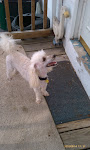
I adopted a rescued miniature poodle named Scruffy on Saturday.
He's 4 years old, 15 pounds, and just wonderful.
It was time to fill the empty place in my life.
Here he is on the side of the page.
He's 4 years old, 15 pounds, and just wonderful.
It was time to fill the empty place in my life.
Here he is on the side of the page.
Monday, May 11, 2009
Purina Building Doggie Show Arena
http://www.stltoday.com/stltoday/business/stories.nsf/story/92E9EBDF0F0735EF862575B0008199DB?OpenDocument
Wednesday, April 15, 2009
Bad Humans
http://www.metro.co.uk/weird/article.html?Woman_tapes_puppy_to_fridge&in_article_id=621274&in_page_id=2
Sunday, April 5, 2009
Friday, March 27, 2009
Thursday, March 26, 2009
Puppies Rescued From Puupy Mill Now Ready For Adoption
http://www.stltoday.com/stltoday/news/stories.nsf/stlouiscitycounty/story/891E5E24B7DEDE5E86257585003F9FF9?OpenDocument
Friday, February 27, 2009
Tuesday, November 25, 2008
Therapy For Civilians, Too
http://www.usatoday.com/life/lifestyle/2008-04-29-therapy-pets_N.htm
'Ordinary' pets to the rescue on human-animal therapy teams
Updated 4/30/2008 11:13 AM
By Sharon L. Peters, Special for USA TODAY
DENVER — Most of the time, Biscuit the bulldog is just a regular stubby-legged young dude who runs around the yard collecting sticks and making everyone laugh with his goofy antics.
But each Friday, once he dons his green work vest, he adjusts his jowly mug into an expression of genial concern, discards all thoughts of canine capers and calmly sets about the business of cheering up stroke patients or encouraging children in their classrooms.
PHOTOS: See therapeutic pets in action in Colorado
FIRST-HAND ACCOUNT: Can a reporter and a rescued mutt become a therapy team?
"This is his calling," says his owner, Shannon Pryor, 28, of Wheat Ridge. She recognized Biscuit's highly empathetic nature when he was a wee pup and she was convalescing with a broken foot.
Pryor got herself and Biscuit registered as a pet therapy team through Denver Pet Partners when he was 1 year old, and now they spend Friday mornings at either the Easter Seals stroke rehabilitation center or at Pine Grove Elementary School.
Across the country, thousands of pets and their owners are spending time with the infirm, the depressed or the distressed, as well as with legions of children and adults in difficult straits who get a boost from the unconditional acceptance and cheerful demeanor of an animal.
Therapy dogs, as they are known, are not service dogs, which go through years of specialized training to assist people who have disabilities. Therapy dogs are house pets that have a special affinity for people, a placid demeanor and solid, reliable obedience skills. The ability they have to motivate, cheer, stabilize and calm people began to be widely publicized in recent years. Now, doctors, counselors, teachers, librarians, physical therapists and crisis managers are so convinced of the positive power of animals that they're lining up to request teams to spend healing time with people in their charge.
The pet-owning public is responding in ever-burgeoning numbers. The training program by the Delta Society in Bellevue, Wash., is used by dozens of therapy-animal groups nationwide. It has more than 10,000 teams registered and has experienced 6% to 8% growth a year. Similar growth is reported by Therapy Dog International in Flanders, N.J., which has 15,000 handlers and 18,000 dogs registered, and Therapy Dogs Inc. in Cheyenne, Wyo., which has more than 10,000 dog/handler teams. Thousands more people and pets are registered with smaller groups or simply do their thing without group affiliation.
Training sessions to help owners prepare usually are booked solid. "We always have a waiting list," says Denver Pet Partners' Diana McQuarrie, who conducts four sessions a year.
Cats and birds get into the act
With each passing month, the whole pet-therapy arena seems to evolve:
•Dogs aren't the only species being used. Cats, llamas, miniature horses, rabbits and birds have been trained and registered.
•Dozens of new applications are being tried. Therapy animals are frequenting schools to help with reading programs or with special-education students, funeral homes to comfort survivors, disaster sites to help quell the chaos and prisons to offer non-judgmental friendship. The U.S. military sent the first therapy dogs to a war zone in December to help the troops in Iraq.
"Every year we see more activity, more acceptance," says Marie Belew Wheatley, president and CEO of the American Humane Association in Denver. Wheatley is so convinced of the trajectory of pet therapy that American Humane took Denver Pet Partners under its umbrella last year and is creating a division this year to study and perpetuate the human/animal bond. A key goal will be to help communities establish or enhance programs. "I predict (pet therapy) will be an integral part of how maladies of all sorts are treated in the future," she says.
Contrary to popular belief, there's no ideal breed for this sort of volunteer work. "They can be 3 pounds to 150 pounds, of any breed," Delta Society's JoAnn Turnbull says. Some dogs have disabilities, and "30% of the dogs we register are from shelters or rescue groups."
Rewards are in the smiles
Stories abound about animals so adept at plugging into people in need "that the handlers are no longer guiding the dogs; the dog knows intuitively which person needs the most attention, and the handler just lets it happen," Turnbull says.
Says Therapy Dogs' Teri Meadows, "Getting a child to speak who has been quiet for months, or experiencing any of the hundreds of other happy reactions your dog can get from someone, well, there's just nothing else like it."
Pryor recalls the time Biscuit was sitting quietly with a stroke patient who was listlessly doing physical therapy, reaching forward to pet the dog, but only with her good side. Biscuit got up and lay on the side of the woman that had been damaged by the stroke, the side she wouldn't use. The therapist asked her to reach with that side and pat the dog. With great effort, she did.
"And Biscuit leaped up and licked her," Pryor says. "He knew this was a great moment, and it's almost as if he were congratulating her."
Licking of patients is a no-no, and Pryor told him to stop. But the woman announced she liked it "and smiled a huge smile, the first smile I'd ever seen from her."
Says Ursula Kempe of Therapy Dog International: "When a dog brightens the life of a person, it's the greatest. It's why people do this with their animals."
'Ordinary' pets to the rescue on human-animal therapy teams
Updated 4/30/2008 11:13 AM
By Sharon L. Peters, Special for USA TODAY
DENVER — Most of the time, Biscuit the bulldog is just a regular stubby-legged young dude who runs around the yard collecting sticks and making everyone laugh with his goofy antics.
But each Friday, once he dons his green work vest, he adjusts his jowly mug into an expression of genial concern, discards all thoughts of canine capers and calmly sets about the business of cheering up stroke patients or encouraging children in their classrooms.
PHOTOS: See therapeutic pets in action in Colorado
FIRST-HAND ACCOUNT: Can a reporter and a rescued mutt become a therapy team?
"This is his calling," says his owner, Shannon Pryor, 28, of Wheat Ridge. She recognized Biscuit's highly empathetic nature when he was a wee pup and she was convalescing with a broken foot.
Pryor got herself and Biscuit registered as a pet therapy team through Denver Pet Partners when he was 1 year old, and now they spend Friday mornings at either the Easter Seals stroke rehabilitation center or at Pine Grove Elementary School.
Across the country, thousands of pets and their owners are spending time with the infirm, the depressed or the distressed, as well as with legions of children and adults in difficult straits who get a boost from the unconditional acceptance and cheerful demeanor of an animal.
Therapy dogs, as they are known, are not service dogs, which go through years of specialized training to assist people who have disabilities. Therapy dogs are house pets that have a special affinity for people, a placid demeanor and solid, reliable obedience skills. The ability they have to motivate, cheer, stabilize and calm people began to be widely publicized in recent years. Now, doctors, counselors, teachers, librarians, physical therapists and crisis managers are so convinced of the positive power of animals that they're lining up to request teams to spend healing time with people in their charge.
The pet-owning public is responding in ever-burgeoning numbers. The training program by the Delta Society in Bellevue, Wash., is used by dozens of therapy-animal groups nationwide. It has more than 10,000 teams registered and has experienced 6% to 8% growth a year. Similar growth is reported by Therapy Dog International in Flanders, N.J., which has 15,000 handlers and 18,000 dogs registered, and Therapy Dogs Inc. in Cheyenne, Wyo., which has more than 10,000 dog/handler teams. Thousands more people and pets are registered with smaller groups or simply do their thing without group affiliation.
Training sessions to help owners prepare usually are booked solid. "We always have a waiting list," says Denver Pet Partners' Diana McQuarrie, who conducts four sessions a year.
Cats and birds get into the act
With each passing month, the whole pet-therapy arena seems to evolve:
•Dogs aren't the only species being used. Cats, llamas, miniature horses, rabbits and birds have been trained and registered.
•Dozens of new applications are being tried. Therapy animals are frequenting schools to help with reading programs or with special-education students, funeral homes to comfort survivors, disaster sites to help quell the chaos and prisons to offer non-judgmental friendship. The U.S. military sent the first therapy dogs to a war zone in December to help the troops in Iraq.
"Every year we see more activity, more acceptance," says Marie Belew Wheatley, president and CEO of the American Humane Association in Denver. Wheatley is so convinced of the trajectory of pet therapy that American Humane took Denver Pet Partners under its umbrella last year and is creating a division this year to study and perpetuate the human/animal bond. A key goal will be to help communities establish or enhance programs. "I predict (pet therapy) will be an integral part of how maladies of all sorts are treated in the future," she says.
Contrary to popular belief, there's no ideal breed for this sort of volunteer work. "They can be 3 pounds to 150 pounds, of any breed," Delta Society's JoAnn Turnbull says. Some dogs have disabilities, and "30% of the dogs we register are from shelters or rescue groups."
Rewards are in the smiles
Stories abound about animals so adept at plugging into people in need "that the handlers are no longer guiding the dogs; the dog knows intuitively which person needs the most attention, and the handler just lets it happen," Turnbull says.
Says Therapy Dogs' Teri Meadows, "Getting a child to speak who has been quiet for months, or experiencing any of the hundreds of other happy reactions your dog can get from someone, well, there's just nothing else like it."
Pryor recalls the time Biscuit was sitting quietly with a stroke patient who was listlessly doing physical therapy, reaching forward to pet the dog, but only with her good side. Biscuit got up and lay on the side of the woman that had been damaged by the stroke, the side she wouldn't use. The therapist asked her to reach with that side and pat the dog. With great effort, she did.
"And Biscuit leaped up and licked her," Pryor says. "He knew this was a great moment, and it's almost as if he were congratulating her."
Licking of patients is a no-no, and Pryor told him to stop. But the woman announced she liked it "and smiled a huge smile, the first smile I'd ever seen from her."
Says Ursula Kempe of Therapy Dog International: "When a dog brightens the life of a person, it's the greatest. It's why people do this with their animals."
Doggies Help Troops With Stress
http://www.usatoday.com/news/health/2007-12-12-dogs-of-war_N.htm
Dogs of war bring soldiers peace of mind
Updated 12/12/2007 10:10 PM
Todd Plitt, USA TODAY
Boe and Budge will be the first therapy dogs to help military people in Iraq who endure combat stress.
HISTORY OF HELPING
America's VetDogs, which trained Boe and Budge, is a subsidiary of the non-profit Guide Dog Foundation for the Blind, which has trained thousands of dogs for the visually impaired since the 1940s.
The foundation in Smithtown, N.Y., made special provisions in its early days to serve military-service veterans and in 60 years has provided guide dogs for hundreds, officials say.
Three years ago the organization began training additional kinds of dogs for veterans with mobility problems and more recently has trained therapy dogs.
America's VetDogs (VetDogs.org) became a distinct entity of the Guide Dog Foundation earlier this year.
By Sharon L. Peters, Special for USA TODAY
Stressed troops in Iraq will get a first-of-its-kind holiday gift later this month: two long-eared, highly sensitive black Labrador retrievers that military officials hope will help soldiers navigate the ragged emotions of life in a war zone.
The specially selected and trained therapy dogs, Boe (pronounced Bo) and Budge, will be attached to combat stress units in Tikrit and Mosul, where "they'll be a vital part of the medical team" that helps troops struggling with stress, sleep disorders and event-related trauma, says Army Staff Sgt. Mike Calaway. He's one of two occupational-therapy assistants sent stateside to receive therapy-dog-handling instruction and return Boe and Budge to the 85th Medical Detachment combat-stress control unit.
This is the first time the military has placed therapy dogs in a combat zone, so it is unknown precisely to what degree troops will connect with and benefit from them. "We have a blank page," says Staff Sgt. Jack Greene. "We're writing on the page. We don't know what's going to be at the bottom of the page until we get there."
But at a minimum, the dogs "will be able to serve as an icebreaker and a communication link" between troubled troops and care providers, says Mike Sargeant, chief training officer for the non-profit America's VetDogs. Sergeant began preparing the 2-year-old Labs earlier this year after the Army queried whether the psychological benefits that therapy dogs provide stateside troops could be replicated in Iraq.
Jumping to the challenge
Therapy dogs offer affection without regard to "gender, race, disability or injury," says Sargeant, and in many settings, troubled people have come to regard the animal as "a safe haven of communication" and have opened up in ways they have not with humans. It's "too new to know just how far the magic will go" in a combat environment, he says, but he's convinced the two dogs are ideally suited to the challenge.
Boe and Budge are similar to each other in their affection for people and ability to tune into individuals' emotional states, but they have their own distinct personalities, Sargeant says. Boe is a stocky female with a playful nature who will cheerfully spend hours at someone's feet if that's what is asked, and Budge is a spunky male who's hard-wired to please.
Unlike guide or service dogs, therapy dogs aren't trained to alert people to ringing phones, maneuver them up or down stairs or pick up dropped items. Therapy dogs are trained to plug into humans and to be "completely non-judgmental," says Sargeant; that often prompts people to expose their vulnerabilities, uncap emotions and move past their difficulties.
Therapy dogs routinely undergo six to eight months of special training to ensure that, among other things, they'll keep their focus on people, no matter the distractions. Boe and Budge were put through additional paces to prepare for the sights, sounds and scents of a war zone. They've been acclimated to helicopter noise, explosions, gunfire, sirens and people from many cultures.
Also, most therapy dogs, which generally work with frail or ailing adults and children in hospitals, nursing homes, medical offices and other care facilities, are typically chosen for being "extremely soft with very low energy levels," Sargeant says, so they'll be content with prolonged inactivity. But knowing that the Army canines would be working very long days with people in their 20s, 30s and 40s who might benefit from some play or roughhousing with a dog, Sargeant wanted high-sensitivity dogs with great energy, and Budge and Boe qualified.
Both dogs know that when their therapy-dog jackets are put on, "they're on duty," Sargeant says. And no hurled tennis ball can cause them to lose their focus on people in their sphere. But when they're not working, they happily engage in raucous merrymaking.
The two dogs, born and trained on Long Island, N.Y., have spent 24 hours a day with their new handlers since Sunday, says Jeff Bressler, America's VetDogs executive vice president, and the four of them have undergone at least 10 hours of training with Sargeant every day since.
Four-footed foot soldiers
Boe and Budge will fly to Fort Hood in Texas this weekend, where they'll undergo military physicals with Army veterinarians and be commissioned as Army sergeants. Next week they'll board a military charter plane to Kuwait (they'll fly in the cabin, not in crates beneath the plane) and from there journey to their respective units. Although travel in Iraq is not always direct or precisely on schedule, they're expected to reach their destinations by Christmas or soon after.
Sending therapy graduates into a war zone thousands of miles away is sweetened by the knowledge that "we know they're going on a very important mission," Bressler says.
"I know what they can give back to people," Sargeant says. "I'm going to be proud."
Budge and Boe "will be in areas that are kept safe," he says.
When the dogs' tour in Iraq ends — possibly years from now — they'll likely be deployed with the handlers they have at that time to a new locale or reassigned to a military hospital in the USA.
Dogs of war bring soldiers peace of mind
Updated 12/12/2007 10:10 PM
Todd Plitt, USA TODAY
Boe and Budge will be the first therapy dogs to help military people in Iraq who endure combat stress.
HISTORY OF HELPING
America's VetDogs, which trained Boe and Budge, is a subsidiary of the non-profit Guide Dog Foundation for the Blind, which has trained thousands of dogs for the visually impaired since the 1940s.
The foundation in Smithtown, N.Y., made special provisions in its early days to serve military-service veterans and in 60 years has provided guide dogs for hundreds, officials say.
Three years ago the organization began training additional kinds of dogs for veterans with mobility problems and more recently has trained therapy dogs.
America's VetDogs (VetDogs.org) became a distinct entity of the Guide Dog Foundation earlier this year.
By Sharon L. Peters, Special for USA TODAY
Stressed troops in Iraq will get a first-of-its-kind holiday gift later this month: two long-eared, highly sensitive black Labrador retrievers that military officials hope will help soldiers navigate the ragged emotions of life in a war zone.
The specially selected and trained therapy dogs, Boe (pronounced Bo) and Budge, will be attached to combat stress units in Tikrit and Mosul, where "they'll be a vital part of the medical team" that helps troops struggling with stress, sleep disorders and event-related trauma, says Army Staff Sgt. Mike Calaway. He's one of two occupational-therapy assistants sent stateside to receive therapy-dog-handling instruction and return Boe and Budge to the 85th Medical Detachment combat-stress control unit.
This is the first time the military has placed therapy dogs in a combat zone, so it is unknown precisely to what degree troops will connect with and benefit from them. "We have a blank page," says Staff Sgt. Jack Greene. "We're writing on the page. We don't know what's going to be at the bottom of the page until we get there."
But at a minimum, the dogs "will be able to serve as an icebreaker and a communication link" between troubled troops and care providers, says Mike Sargeant, chief training officer for the non-profit America's VetDogs. Sergeant began preparing the 2-year-old Labs earlier this year after the Army queried whether the psychological benefits that therapy dogs provide stateside troops could be replicated in Iraq.
Jumping to the challenge
Therapy dogs offer affection without regard to "gender, race, disability or injury," says Sargeant, and in many settings, troubled people have come to regard the animal as "a safe haven of communication" and have opened up in ways they have not with humans. It's "too new to know just how far the magic will go" in a combat environment, he says, but he's convinced the two dogs are ideally suited to the challenge.
Boe and Budge are similar to each other in their affection for people and ability to tune into individuals' emotional states, but they have their own distinct personalities, Sargeant says. Boe is a stocky female with a playful nature who will cheerfully spend hours at someone's feet if that's what is asked, and Budge is a spunky male who's hard-wired to please.
Unlike guide or service dogs, therapy dogs aren't trained to alert people to ringing phones, maneuver them up or down stairs or pick up dropped items. Therapy dogs are trained to plug into humans and to be "completely non-judgmental," says Sargeant; that often prompts people to expose their vulnerabilities, uncap emotions and move past their difficulties.
Therapy dogs routinely undergo six to eight months of special training to ensure that, among other things, they'll keep their focus on people, no matter the distractions. Boe and Budge were put through additional paces to prepare for the sights, sounds and scents of a war zone. They've been acclimated to helicopter noise, explosions, gunfire, sirens and people from many cultures.
Also, most therapy dogs, which generally work with frail or ailing adults and children in hospitals, nursing homes, medical offices and other care facilities, are typically chosen for being "extremely soft with very low energy levels," Sargeant says, so they'll be content with prolonged inactivity. But knowing that the Army canines would be working very long days with people in their 20s, 30s and 40s who might benefit from some play or roughhousing with a dog, Sargeant wanted high-sensitivity dogs with great energy, and Budge and Boe qualified.
Both dogs know that when their therapy-dog jackets are put on, "they're on duty," Sargeant says. And no hurled tennis ball can cause them to lose their focus on people in their sphere. But when they're not working, they happily engage in raucous merrymaking.
The two dogs, born and trained on Long Island, N.Y., have spent 24 hours a day with their new handlers since Sunday, says Jeff Bressler, America's VetDogs executive vice president, and the four of them have undergone at least 10 hours of training with Sargeant every day since.
Four-footed foot soldiers
Boe and Budge will fly to Fort Hood in Texas this weekend, where they'll undergo military physicals with Army veterinarians and be commissioned as Army sergeants. Next week they'll board a military charter plane to Kuwait (they'll fly in the cabin, not in crates beneath the plane) and from there journey to their respective units. Although travel in Iraq is not always direct or precisely on schedule, they're expected to reach their destinations by Christmas or soon after.
Sending therapy graduates into a war zone thousands of miles away is sweetened by the knowledge that "we know they're going on a very important mission," Bressler says.
"I know what they can give back to people," Sargeant says. "I'm going to be proud."
Budge and Boe "will be in areas that are kept safe," he says.
When the dogs' tour in Iraq ends — possibly years from now — they'll likely be deployed with the handlers they have at that time to a new locale or reassigned to a military hospital in the USA.
Air Doggies!
http://www.usatoday.com/news/nation/2008-11-25-pilots-dog-rescue_N.htm
Pilots fly doomed dogs to better life
By Sharon L. Peters, Special for USA TODAY
Puppy love is reaching new heights.
Pilots are donating their time, planes and fuel to transport dozens of dogs a month from overcrowded shelters where they face almost certain death to rescue groups and shelters several states away that are committed to finding them homes.
The mission-of-mercy relocations are flown by general aviation pilots who have signed on with the recently formed Pilots N Paws, a Web-based message board where pilots can access information about animals in need.
Once the electronic connection is made, dogs plucked by rescuers from death row — mostly in the South where sterilization rates are low and pet overpopulation is rampant — are loaded onto small planes and flown one, two or six at a time to rescue groups and shelters that have available space.
"These are wonderful dogs that simply had the bad luck of winding up in a place where there are too many pets in shelters," says Pilots N Paws co-founder Jon Wehrenberg of Knoxville, Tenn. The retired manufacturing executive and weekend pilot has flown scores of dogs from high-kill shelters this year. Earlier this month, his mission involved six small mixed-breed dogs from Knoxville's Young-Williams Animal Center.
The happy half-dozen enjoyed a smooth-sailing, 90-minute flight to Greensboro, N.C., where they were met by radio station executive Jennifer Hart, head of Animal Rescue & Foster Program, who had arranged foster care. One dog has been adopted; the others are receiving additional attention, socialization and training and should be ready for new homes soon after Thanksgiving.
Beginning of the journey
"Pilots N Paws has given about 20 of our animals a second chance," says Tim Adams, executive director of the Young-Williams shelter, which euthanizes 70% of the animals that land there. "We take in 17,000 animals a year, and Knoxville simply isn't big enough… to get new homes for them here. Twenty animals saved may not sound like much, but every one of them matters."
Pilots N Paws started operating in February soon after Wehrenberg offered to fly a Doberman in Florida to his pal Debi Boies of Landrum, S.C., who is a retired nurse, horse breeder and long-time rescuer. He began asking questions about the rescue world and learned about the passionate underground railroad of animal lovers who orchestrate days-long road journeys to save some of the 4 million to 6 million animals destined for euthanasia in U.S. shelters annually.
"I'd had no idea of the number of animals being euthanized, and the ordeal people and animals were going through in transports," Wehrenberg says. "Pilots love to fly. I believed that if we created a means for them to discover situations where they could fly and also save animals, many would do it."
He and Boies joined forces to spread the word, and within months, 85 pilots had signed on. Nearly 200 dogs have now been flown from several shelters and rescue groups to welcoming arms hundreds of miles away.
"For most of these dogs, the next walk they would have taken would have been to death's door," says administrative assistant Dawn Thompson of Falconer, N.Y., who for 18 years has taken in, nursed, socialized and re-homed more than 100 dogs a year from various high-kill areas. In recent months 30 have arrived via Pilots N Paws, and she's learned the ones that arrive by plane rather than ground transport "don't have the stress that two days on the road creates, and that makes them almost instantly adoptable."
'Doggy kisses' are worth gas
Each flight costs the pilot hundreds of dollars in fuel alone, not including routine maintenance and other operating expenses. Boies and Wehrenberg are working to gain non-profit status for the group so pilots could declare the fuel costs a charitable contribution. But the pilots aren't exactly agitating for that.
"Doggy kisses are worth the $6 a gallon," says Westminster, Md., businesswoman and small-plane pilot Michele McGuire. She was recently part of a two-leg rely that flew a 110-pound skin-and-bones Great Dane from Arab, Ala., where a rescue group saved it from euthanasia, to a new family in Baldwin, Mass.
"I don't know what (the animals') opinion of flying is, but it sure makes their trip a lot shorter," says Nick O'Connell, a Williamsburg, Va., contractor who did his first such flight earlier this month. The two-leg hand-off involved two pilots, several hundred miles and two chow-mix puppies rescued from a dump near Atlanta and delivered to their new family in Chesterfield, Va.
The animals are almost always remarkably calm about the adventure, O'Connell and other pilots report.
"It's almost as if they understand that this is their chance for life," Boies says.
Sometimes pilots scroll through the "Transport needed" section of Pilots N Paws and find a plea to fly an animal to a town or city they already were planning to visit.
Most times, however, they study the requests, see a need that touches them and offer their services.
Broomfield, Colo., software engineer/pilot Mike Boyd was involved in a multi-state, multi-person transport of a German shepherd in October, and he's aiming to do more missions. "To take my hobby and apply it to help this situation, well, it's just a great feeling," he says.
Adds O'Connell: "It is rewarding beyond my wildest imagination."
Pilots fly doomed dogs to better life
By Sharon L. Peters, Special for USA TODAY
Puppy love is reaching new heights.
Pilots are donating their time, planes and fuel to transport dozens of dogs a month from overcrowded shelters where they face almost certain death to rescue groups and shelters several states away that are committed to finding them homes.
The mission-of-mercy relocations are flown by general aviation pilots who have signed on with the recently formed Pilots N Paws, a Web-based message board where pilots can access information about animals in need.
Once the electronic connection is made, dogs plucked by rescuers from death row — mostly in the South where sterilization rates are low and pet overpopulation is rampant — are loaded onto small planes and flown one, two or six at a time to rescue groups and shelters that have available space.
"These are wonderful dogs that simply had the bad luck of winding up in a place where there are too many pets in shelters," says Pilots N Paws co-founder Jon Wehrenberg of Knoxville, Tenn. The retired manufacturing executive and weekend pilot has flown scores of dogs from high-kill shelters this year. Earlier this month, his mission involved six small mixed-breed dogs from Knoxville's Young-Williams Animal Center.
The happy half-dozen enjoyed a smooth-sailing, 90-minute flight to Greensboro, N.C., where they were met by radio station executive Jennifer Hart, head of Animal Rescue & Foster Program, who had arranged foster care. One dog has been adopted; the others are receiving additional attention, socialization and training and should be ready for new homes soon after Thanksgiving.
Beginning of the journey
"Pilots N Paws has given about 20 of our animals a second chance," says Tim Adams, executive director of the Young-Williams shelter, which euthanizes 70% of the animals that land there. "We take in 17,000 animals a year, and Knoxville simply isn't big enough… to get new homes for them here. Twenty animals saved may not sound like much, but every one of them matters."
Pilots N Paws started operating in February soon after Wehrenberg offered to fly a Doberman in Florida to his pal Debi Boies of Landrum, S.C., who is a retired nurse, horse breeder and long-time rescuer. He began asking questions about the rescue world and learned about the passionate underground railroad of animal lovers who orchestrate days-long road journeys to save some of the 4 million to 6 million animals destined for euthanasia in U.S. shelters annually.
"I'd had no idea of the number of animals being euthanized, and the ordeal people and animals were going through in transports," Wehrenberg says. "Pilots love to fly. I believed that if we created a means for them to discover situations where they could fly and also save animals, many would do it."
He and Boies joined forces to spread the word, and within months, 85 pilots had signed on. Nearly 200 dogs have now been flown from several shelters and rescue groups to welcoming arms hundreds of miles away.
"For most of these dogs, the next walk they would have taken would have been to death's door," says administrative assistant Dawn Thompson of Falconer, N.Y., who for 18 years has taken in, nursed, socialized and re-homed more than 100 dogs a year from various high-kill areas. In recent months 30 have arrived via Pilots N Paws, and she's learned the ones that arrive by plane rather than ground transport "don't have the stress that two days on the road creates, and that makes them almost instantly adoptable."
'Doggy kisses' are worth gas
Each flight costs the pilot hundreds of dollars in fuel alone, not including routine maintenance and other operating expenses. Boies and Wehrenberg are working to gain non-profit status for the group so pilots could declare the fuel costs a charitable contribution. But the pilots aren't exactly agitating for that.
"Doggy kisses are worth the $6 a gallon," says Westminster, Md., businesswoman and small-plane pilot Michele McGuire. She was recently part of a two-leg rely that flew a 110-pound skin-and-bones Great Dane from Arab, Ala., where a rescue group saved it from euthanasia, to a new family in Baldwin, Mass.
"I don't know what (the animals') opinion of flying is, but it sure makes their trip a lot shorter," says Nick O'Connell, a Williamsburg, Va., contractor who did his first such flight earlier this month. The two-leg hand-off involved two pilots, several hundred miles and two chow-mix puppies rescued from a dump near Atlanta and delivered to their new family in Chesterfield, Va.
The animals are almost always remarkably calm about the adventure, O'Connell and other pilots report.
"It's almost as if they understand that this is their chance for life," Boies says.
Sometimes pilots scroll through the "Transport needed" section of Pilots N Paws and find a plea to fly an animal to a town or city they already were planning to visit.
Most times, however, they study the requests, see a need that touches them and offer their services.
Broomfield, Colo., software engineer/pilot Mike Boyd was involved in a multi-state, multi-person transport of a German shepherd in October, and he's aiming to do more missions. "To take my hobby and apply it to help this situation, well, it's just a great feeling," he says.
Adds O'Connell: "It is rewarding beyond my wildest imagination."
Tuesday, September 16, 2008
Doggie Daycare!
http://www.telegraph.co.uk/education/main.jhtml?xml=/education/2008/09/16/fadogwork116.xml
Subscribe to:
Posts (Atom)

 Posts
Posts

